The tool became the product
A storytelling company’s internal software turned into the business it now sells.


ROLE
Sole Product Designer
TIMELINE
Two years
TEAM
Founder, product manager, in-house engineering, me
PLATFORM
Web application
STAGE
0 → 1
The setup
The company recorded long-form interviews about people’s lives, then editors turned those recordings into short films, articles, and social content. The editors worked in internal software the company had built for itself. It was never meant to be a product; it was the machine behind the service. I was brought in to improve acquisition. Once the founder learned I had product design experience, the scope changed: would I design the interface their editors were using?
The pivot
Something kept happening in sales calls. The prospect would be politely interested in the storytelling, then ask about the software on screen: “How do we get access to that?”. For a while the answer was that it was internal. Prospects kept asking anyway. Content teams recognized their own problem in it: recordings sitting in folders and no way to turn them into usable content at any speed. Eventually the company stopped saying no.
The thing I was designing quietly in the background became the entire business.
The problem
Take one long recording. Produce many pieces of short content from it, each targeted at a different platform and pulling out a genuinely good moment rather than an arbitrary sixty seconds. • A single video contains hundreds of possible clips. • Two very different users: expert editors and untrained marketing or HR teams. • AI output needs a steering wheel. • Nobody wants to learn video editing.
Ask for intent, not settings
The production flow starts with what the person wants, not how the software works. Rather than exposing parameters, it asks for a theme: thought leadership, short story, inspirational, or salient quote. Then approximate length, with optional narrowing by goal, audience, or speaker. Everything a professional editor would think about is expressed as intent instead of controls. An expert can go deeper. A first-time user can produce something usable in three clicks.

Two rooms, not one
The interface splits into a Creator Studio and a Content Studio. Creator Studio is the workbench: timeline, multi-track editing, transcript. Content Studio is where finished output lives and gets organized. Keeping them separate meant the timeline never had to be the front door. Someone who only wants generated clips never has to see it. Someone who wants control has it one click away.
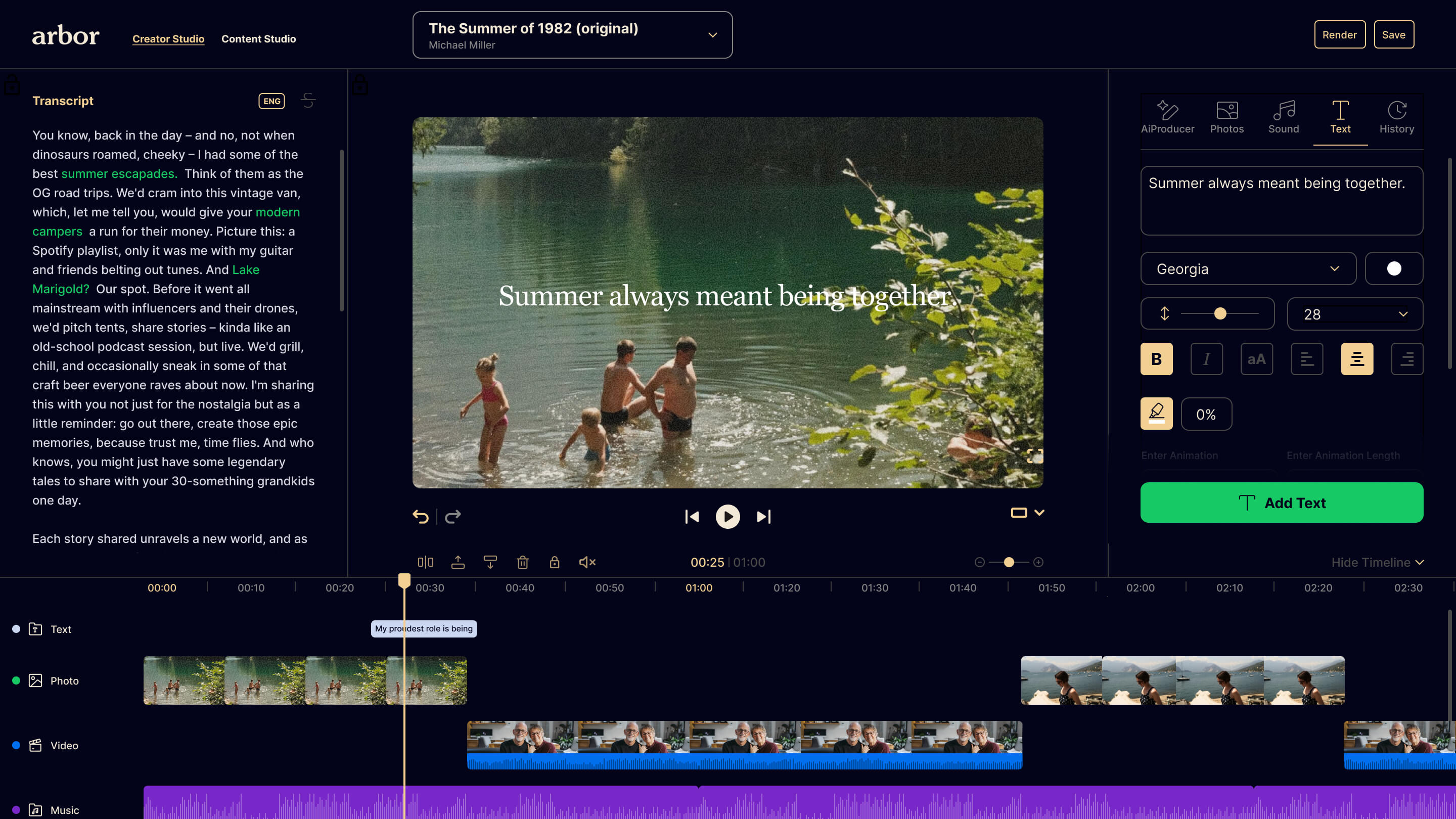

Make output feel like content, not files
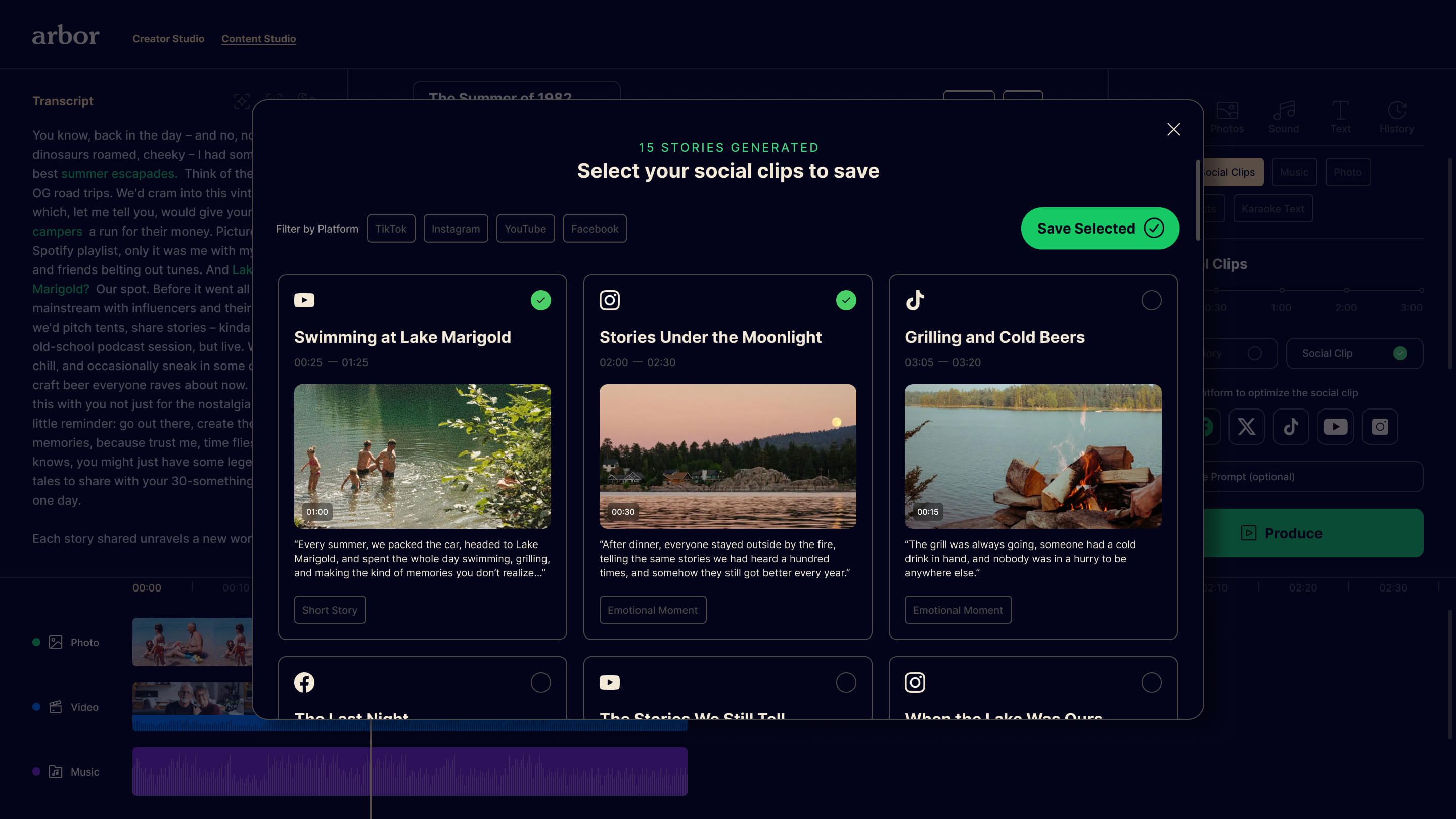
Generated clips render as cards that look like what they will become: a thumbnail, destination platforms, the pulled quote, engagement-style metrics, and thematic tags. A list of exported files is an editing product. A wall of platform-ready cards is a content product. The customer thinks in posts, not renders, so the output had to think in posts too.
How it actually got built
I was the only designer on the team for two years.
With the product manager
Design sprints to scope each build cycle, then flows, screens, interaction specs, and handoff to in-house engineering.
With the head of marketing
The first-touch website, landing pages, and campaigns, keeping product promise and delivery aligned.
With the founder
Future-state concepts for investor and enterprise conversations—speculative by design, with the concepts that landed becoming real specs.
The design system
A system that kept two years of product surface coherent and gave the first full-time product designer documentation instead of a folder of files.
What I had to work with
One designer
Two years of product surface, a marketing site, and a design system without a design peer.
A moving target
The business model changed underneath the product mid-build.
No direct access to customers
After the pivot, feedback came through the founder and sales conversations.
Engineering capacity
A small in-house team meant every design decision had a real build cost.
What I would do differently
I would have built the design system earlier. Starting from a component foundation would have cost a week upfront and saved months. I would also have pushed harder to talk to customers directly once the pivot happened. I was inferring mental models from secondhand signal rather than observing them.
What I learned
UP NEXT

