The evidence has to stand in for the car
A private seller produces the only proof a buyer will ever see. A reviewer decides whether to trust it. I designed both ends.


ROLE
Senior Product Designer
PRODUCT
Sell to Carvana
FOCUS
Seller journey
CHALLENGE
High-stakes transaction
CONTEXT
One-time seller
The premise
Carvana's marketplace let private sellers list cars to private buyers, with Carvana as the platform in between and the financing if the buyer needed it. That removes the person everyone assumes is necessary: nobody inspects the car, nobody meets, nobody shakes hands. A five-figure asset changes hands based entirely on evidence a stranger produced and a reviewer accepted.
The product is a trust pipeline with two ends and a verification step between them.
The seller produces the evidence. A Carvana reviewer verifies it before anything goes live. The buyer trusts the platform, not the stranger. I designed all three.
The seller produces the evidence
The seller has never done this before and will probably never do it again. There is no learning curve to climb, because there is no second attempt. And the failures are invisible to them: a title shot at an angle looks fine on their screen. They find out days later.
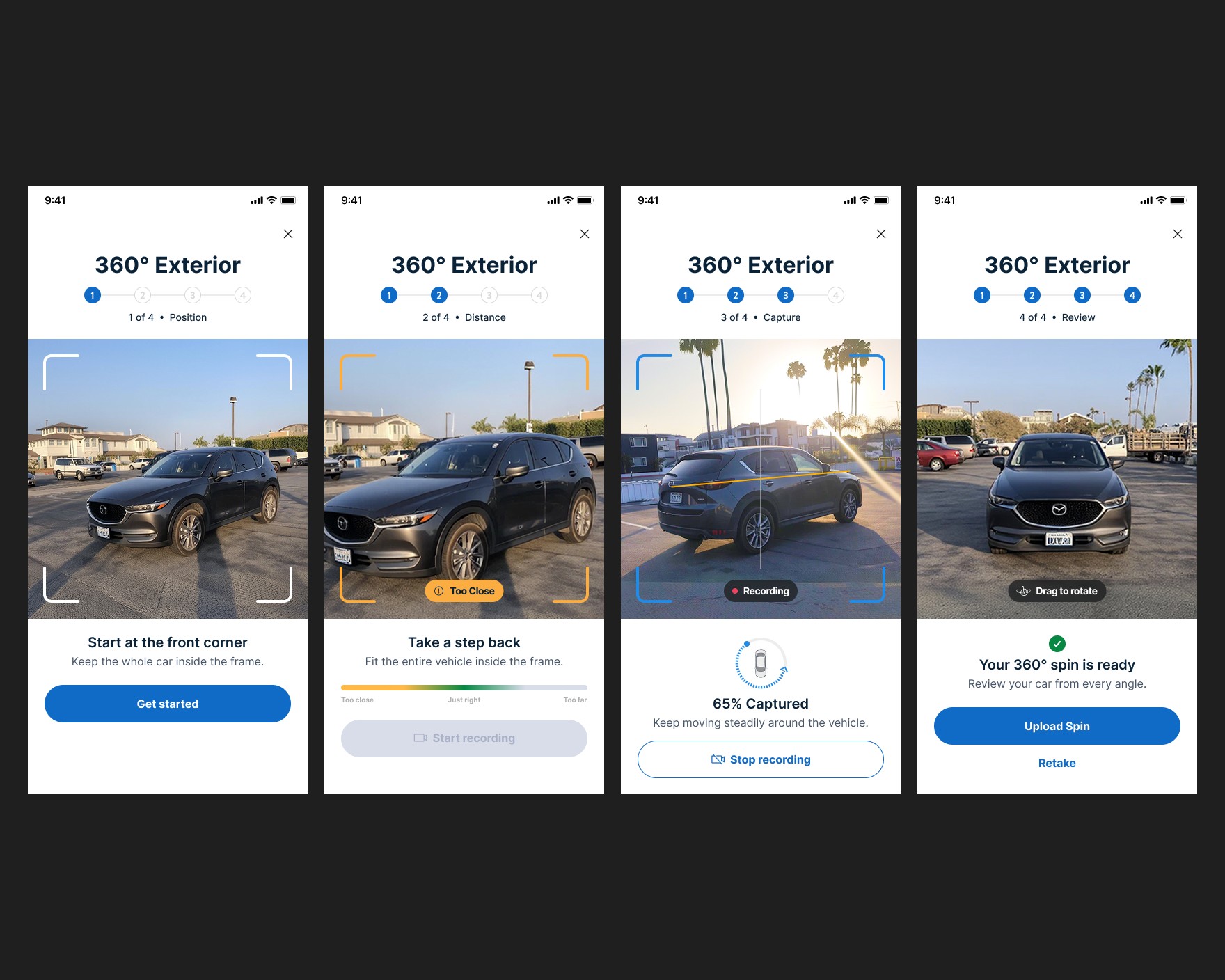
The 360° spin
Carvana's signature is the 360° spin, shot in a purpose-built photo booth with controlled lighting and fixed camera positions. Reproducing that with a consumer, outdoors, on a phone, was the hardest problem I worked on there.
The app guides the seller through recording a full orbit of the car: where to stand, how far back, how fast to move, when to start and stop. It has to communicate a spatial relationship through a screen, in real time, to someone walking backwards in a driveway.
Distance is the whole problem
Too close and the frame clips the car. Too far and detail is lost. Without a usable spin, the listing does not carry the visual credibility a buyer needs, and it does not go live.
Photos and condition
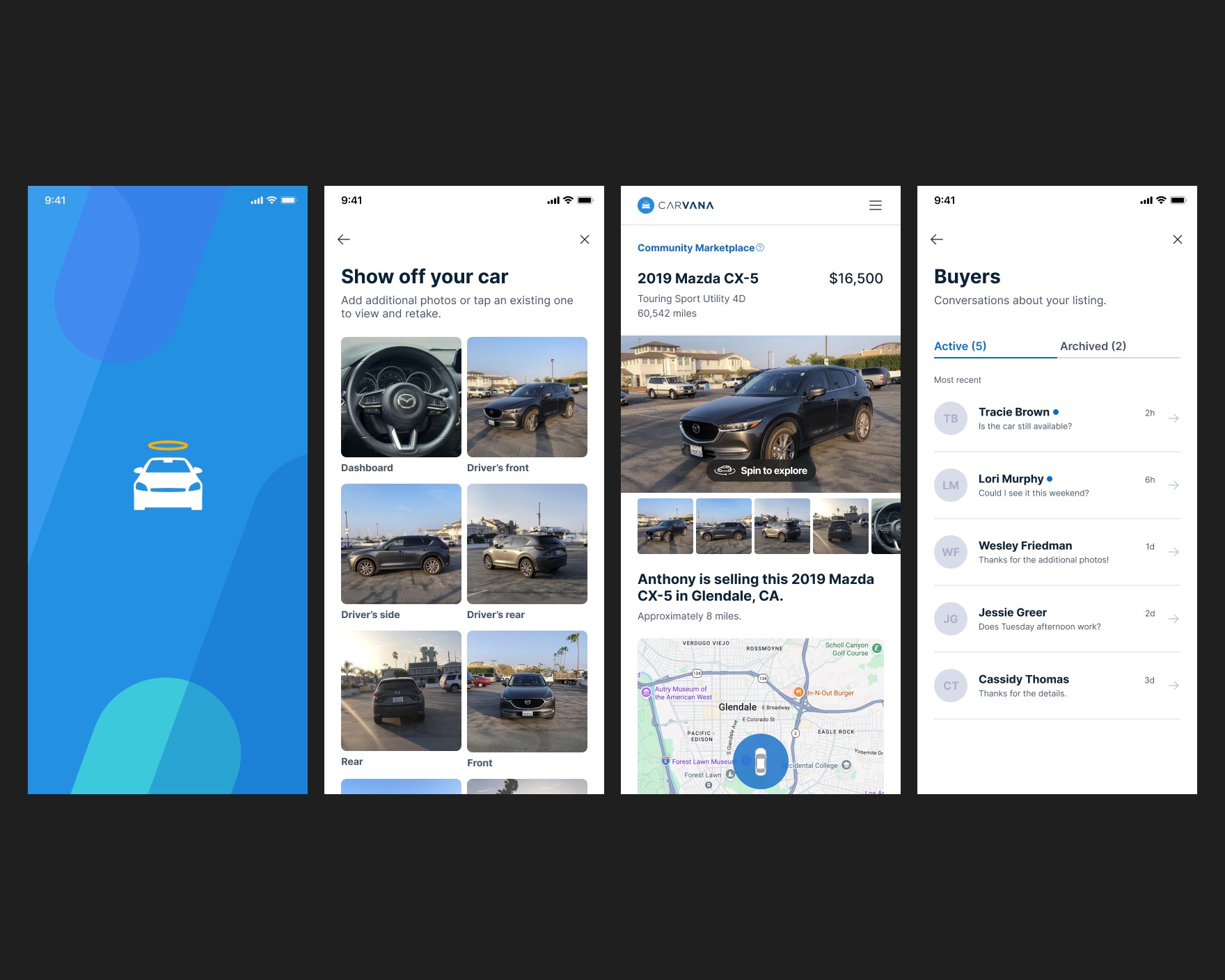
Beyond the spin, the seller captures a structured set: exterior angles, interior, and honest condition images. The flow asks for specific shots rather than leaving it open, because a buyer comparing this listing to a Carvana vehicle expects the same coverage.
Documents
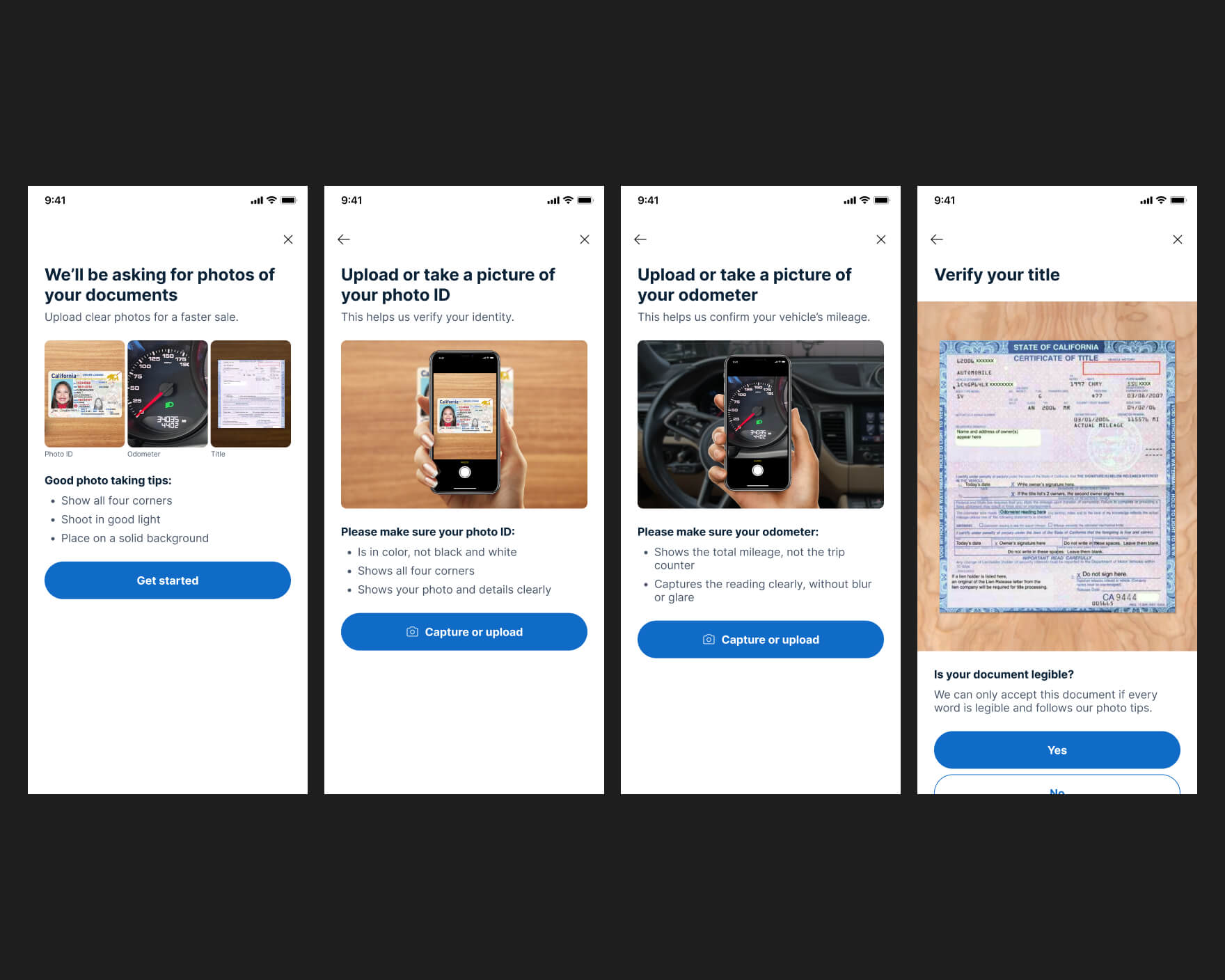
Title, odometer, proof of identity, lien release. Each request is taught before it is asked, demonstrated rather than described, and verified in the moment. The flow asks the seller to confirm what they just captured: Is it legible? All four corners? Is the lien section filled in? Who is listed as an owner? That catches bad captures when a retake costs seconds instead of days, and it surfaces information the system needs anyway.
A reviewer verifies it
Seller evidence does not go straight to a buyer. It goes to a reviewer first, and the review tool is where the trust actually gets built.
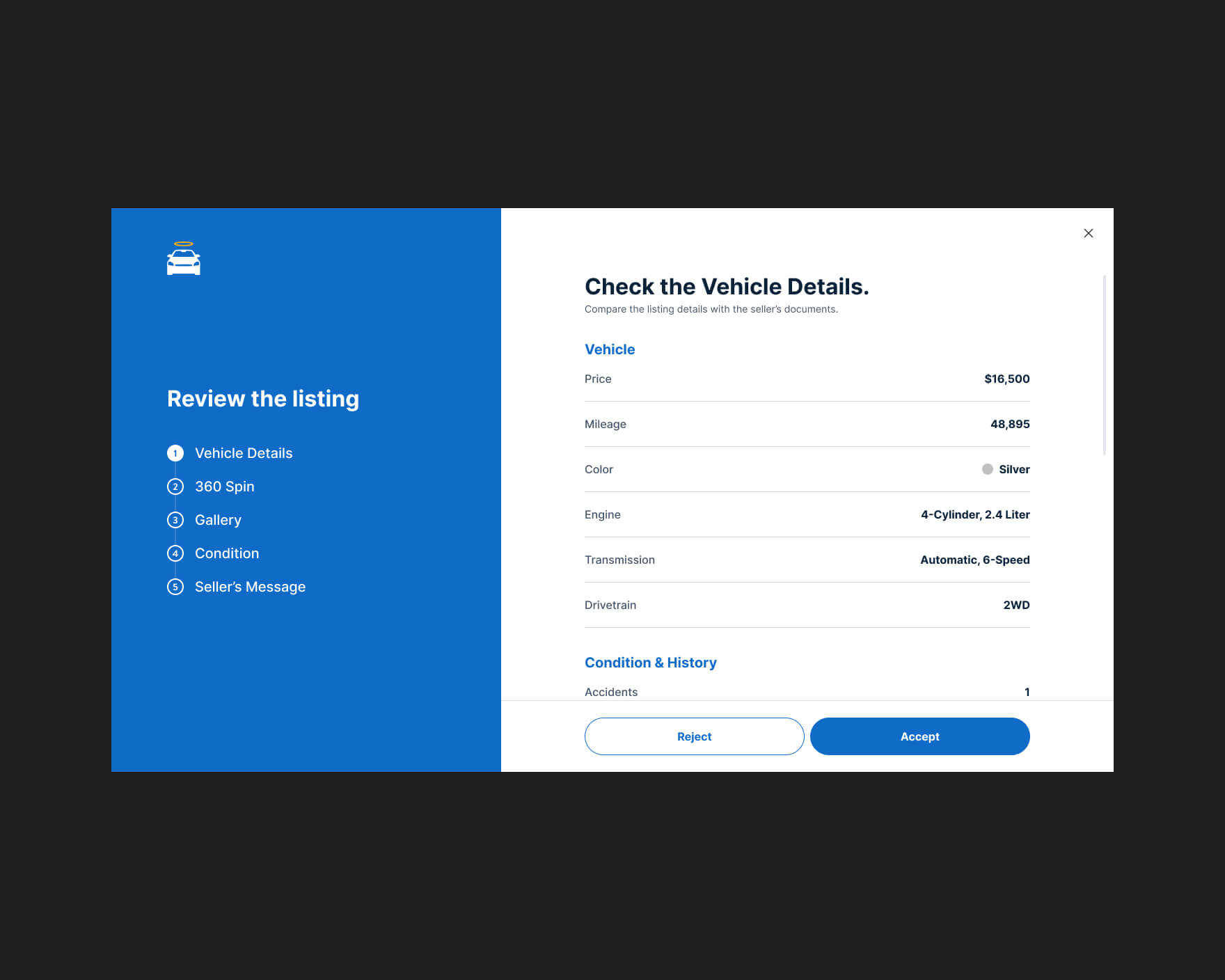
I designed a guided review console that walks a team member through a listing one section at a time: vehicle details, the 360° spin, gallery images, condition images, and the seller's message. A checklist tracks progress; each step is a clear accept-or-reject decision.
Sequence, not a wall.
The old way of reviewing anything complex is a single dense screen. Breaking the review into ordered steps means a reviewer makes one judgment at a time and cannot skip a section by accident.
The reviewer verifies against a standard.
Every question the seller was asked upstream maps to something the reviewer checks downstream. I designed both, so the two halves speak the same language and the reviewer is never guessing what "good" looks like.
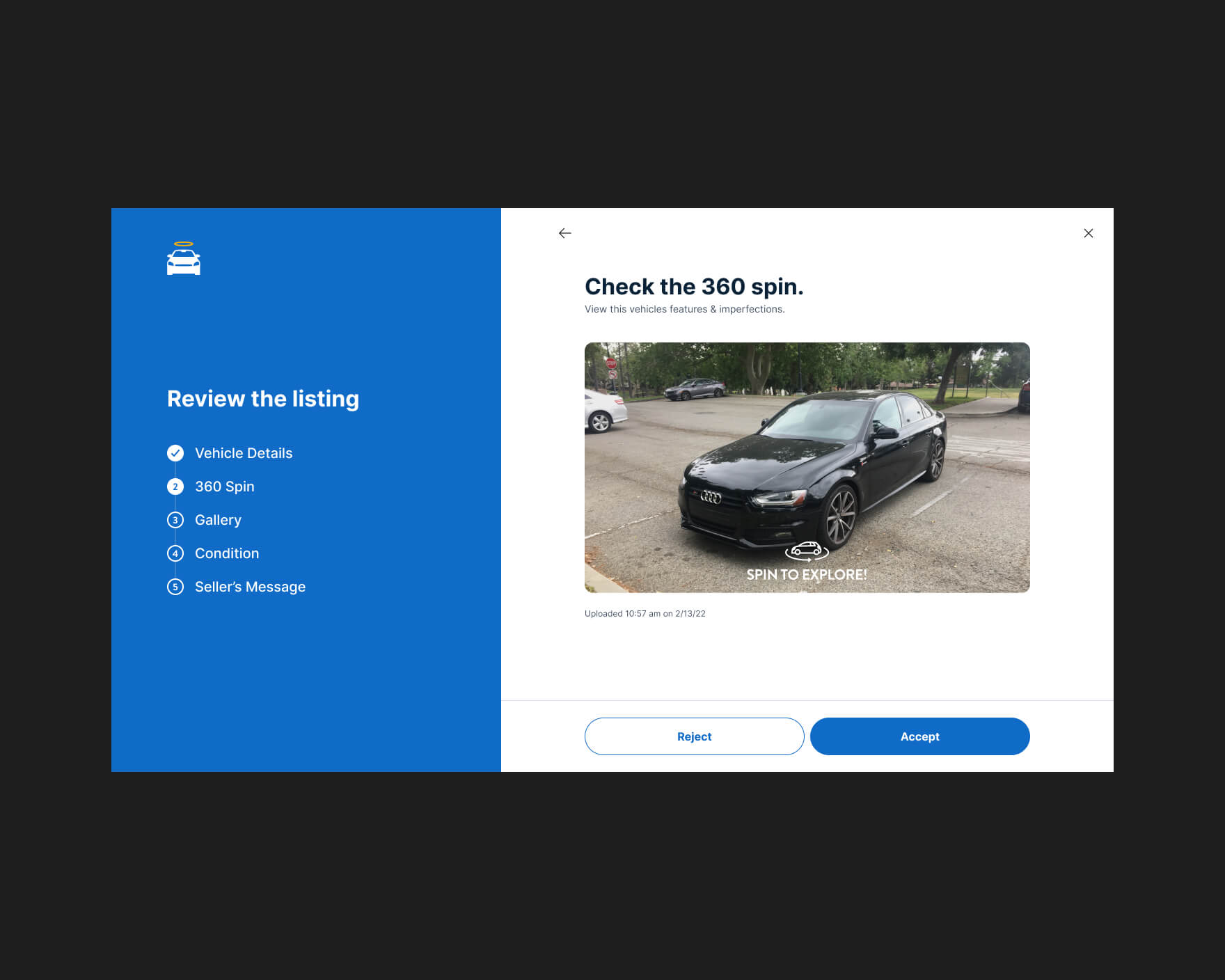
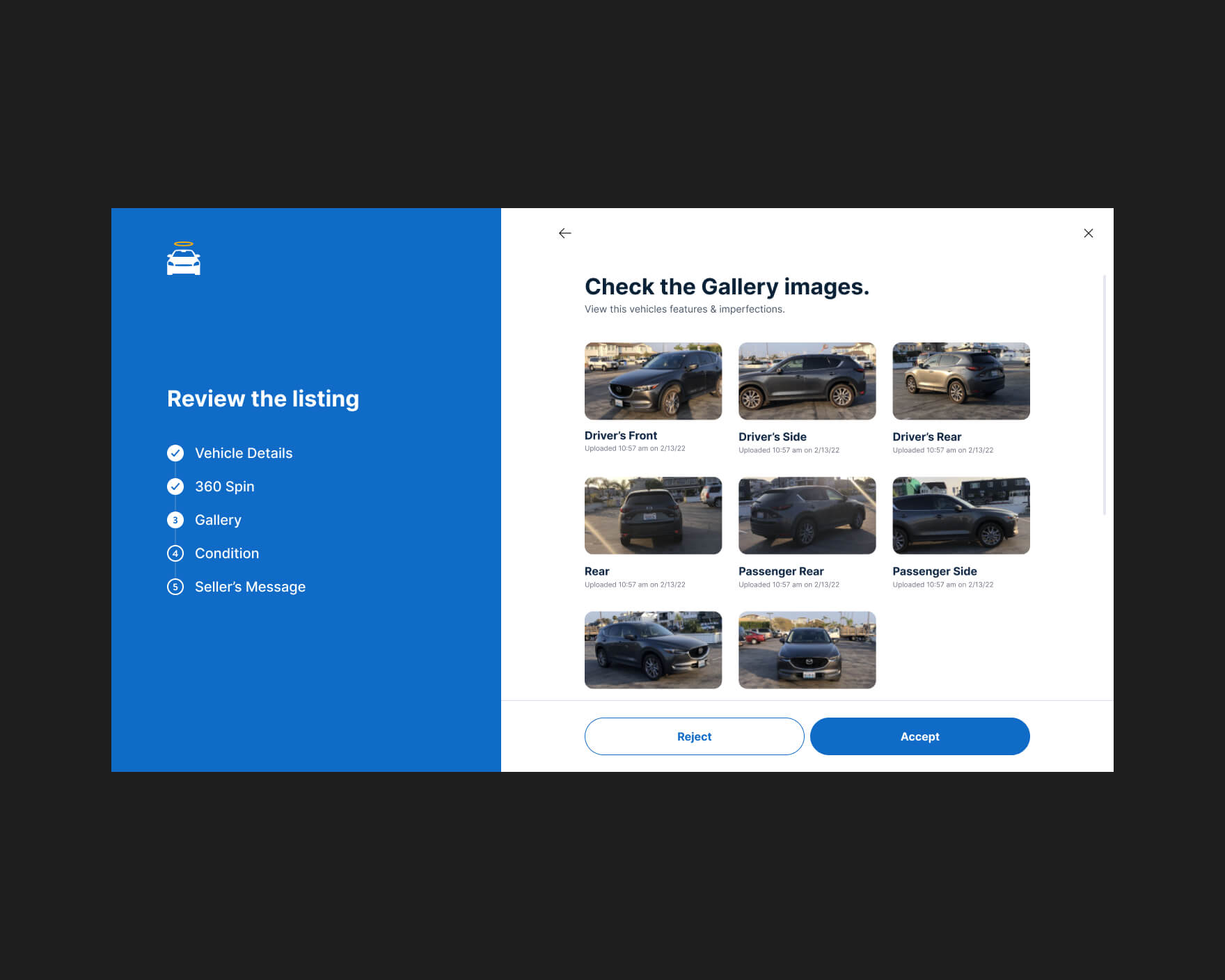
Alongside the per-listing review, I designed the console the internal team lived in: listings organized by state, a listing detail view, and the ingest flow for pulling a vehicle into the system by ID.
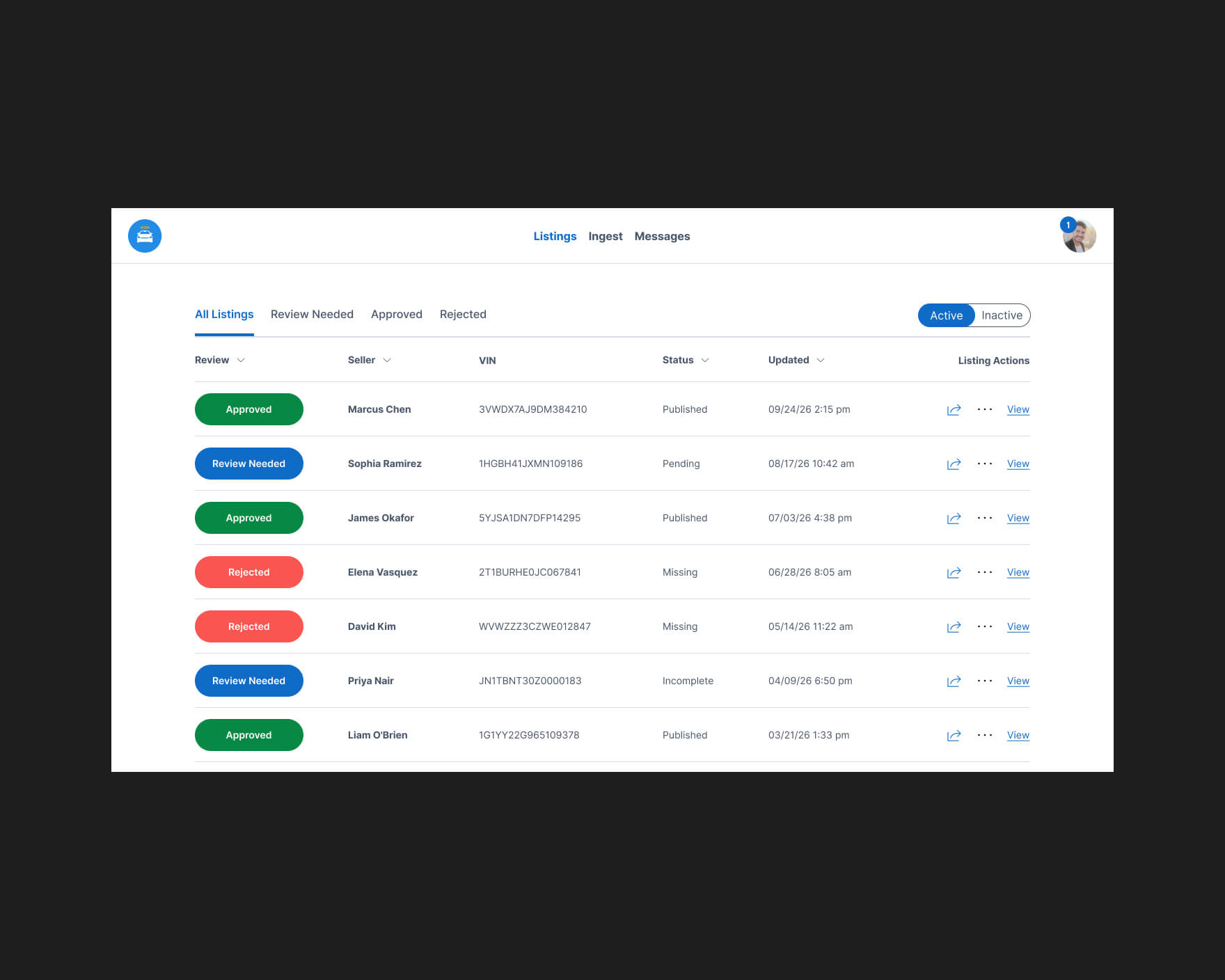
The states are the product. A listing moving from ingested, to review-needed, to approved, to live is the entire operational spine, and making that legible is what let a small team process real volume.
Trust flows one direction
The verification model was the answer to two strangers not knowing each other: neither party has to trust the other, because both trust Carvana.
Sellers produce evidence. Carvana verifies it, both by a reviewer stepping through it and by independent checks against VIN records, vehicle history reports, and its own data. What finally appears on a listing is not a private seller's claim. It is a claim the platform has checked and stands behind.
You cannot make two strangers trust each other. You can make both trust the same third party, if you design the pipeline that earns it.
A buyer browsing the homepage saw private listings and Carvana's own inventory together, with financing either way. For that to work, a private seller's listing had to sit next to a Carvana vehicle without looking like a downgrade. Everything a customer expected from a Carvana listing had to be reproducible by someone with a phone, and verifiable by someone at a desk.
What I had to work with
An established design system.
Carvana had one, and my job was to work inside it rather than around it.
A brand standard set by a photo booth.
The consumer capture had to match visual expectations created by professional studio work, using consumer phones. That gap defined most of the seller-side design.
Both ends of one system, at once.
Designing the seller flow and the reviewer flow together was the point, but every change to what the seller was asked rippled into what the reviewer received. They could not be designed in isolation.
No direct observation of sellers.
What I had was support ticket volume, rejection reasons, and drop-off by step. Behavioral rather than observational, but specific enough to see where people failed and why.
The Outcome
The marketplace was later discontinued as company priorities shifted. The work brought seller capture, internal review, and buyer confidence into one connected experience, with clear guidance at each step.
What I learned
UP NEXT

